Britvex Advisory | UK Tax Made Simple | Reviewed 14 November 2026
The short answer: In the UK, you may have to pay Income Tax on interest earned on savings—not on the money you deposited. Many people pay nothing because of the Personal Allowance, the starting rate for savings or the Personal Savings Allowance. The usual Personal Savings Allowance is £1,000 for basic-rate taxpayers, £500 for higher-rate taxpayers and £0 for additional-rate taxpayers. Interest on a qualifying Cash ISA is generally tax-free. HMRC can use information provided by banks to calculate tax, often collecting it through a PAYE code or issuing a tax calculation. See HMRC’s official savings-interest guidance.
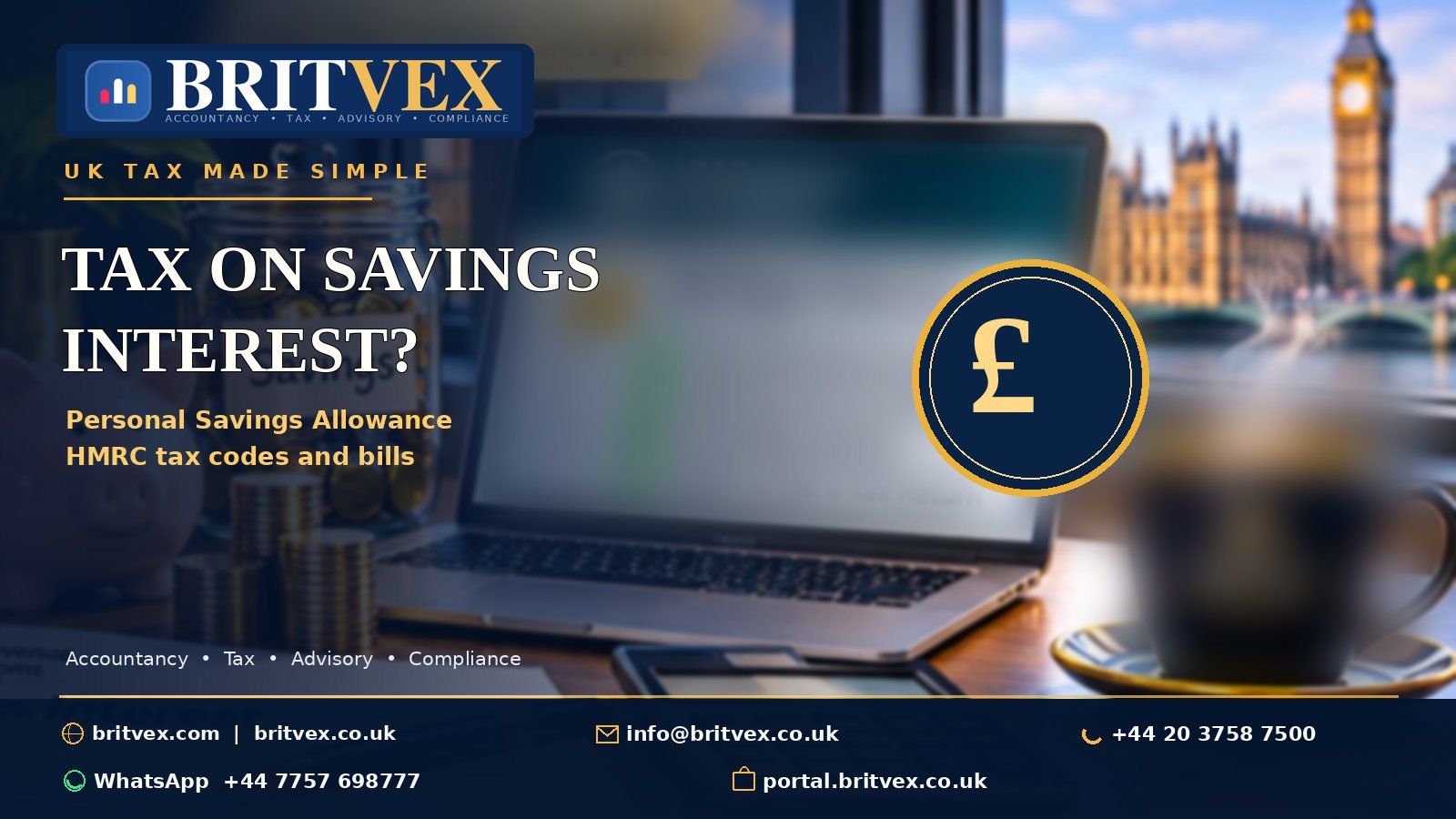
If you have savings in several banks, receive a pension, have an unusual tax code or have received an unexpected bill from HMRC, the calculation can be less obvious. This guide explains what counts, how the allowances interact, how to check the figures and when you may need a tax return or professional review.
Britvex provides UK personal tax and Self Assessment support. If you need help examining a tax calculation, changing a mistaken estimate or reporting savings alongside other income, request a quote with a summary of your circumstances. Never send online banking passwords or Government Gateway login details.
What is taxed: your interest, not the savings balance
If you hold £40,000 in a savings account paying 4% annual interest, the interest would be about £1,600 for a full year at that simple rate, ignoring compounding and changes in balance. The original £40,000 is not income merely because it sits in the bank. Tax may apply to the £1,600 interest after relevant allowances and based on your other taxable income.
Banks commonly pay most ordinary interest without deducting Income Tax. That is why people are surprised when an HMRC letter arrives later. It does not mean your bank has charged a second tax or that a new tax has been imposed on savings capital.
Sources of potentially taxable savings income include interest from ordinary bank and building-society accounts, some credit-union accounts, certain bonds, peer-to-peer loans and other eligible savings products. Their tax treatment can differ. Cash ISA interest and certain tax-exempt National Savings products generally sit outside the taxable total. A Stocks and Shares ISA has its own tax-free treatment; investment returns outside ISAs can have different dividend or capital-gains rules.
The three tax-free layers you should check first
Many explanations mention only the £1,000 and £500 allowances. That misses two important parts of the calculation for people with smaller non-savings income.
| Relief or allowance | What it does | Practical point |
|---|---|---|
| Personal Allowance | Can cover savings income if it has not already been used by wages, pensions or other taxable income | The 2026–27 standard Personal Allowance is £12,570, subject to individual adjustments |
| Starting rate for savings | Up to £5,000 of eligible savings interest can be taxed at 0%, depending on other income | Reduced by £1 for each £1 of non-savings taxable income above the Personal Allowance |
| Personal Savings Allowance | Allows a further specified amount of savings income at a 0% rate according to the tax band | £1,000 basic, £500 higher, £0 additional-rate taxpayers |
These allowances interact and are not always all available in full. They are applied within the applicable income-tax calculation, not simply deducted from a bank balance. HMRC’s detailed explanation is at How much savings interest is tax-free.
The Personal Savings Allowance does not mean everyone can earn £1,000 tax-free
The taxpayer’s band matters. Your income from work, pensions, rentals and other sources, plus savings interest, determines whether you are within the basic, higher or additional-rate position for this purpose. Someone near a band boundary should not calculate tax using a fixed rate without considering the full income picture.
For savings-tax purposes, UK residents in Scotland are subject to the UK savings-income rates and bands, rather than Scottish non-savings income rates for the savings itself; Scottish non-savings income still affects the overall tax-band calculation. If circumstances involve residence outside the UK, the rules may differ again. Seek a personal calculation if you are near a boundary or have foreign income.
Worked example 1: basic-rate taxpayer with £1,300 interest
Assume a taxpayer’s other income places them within the basic-rate band, they have used their Personal Allowance and the starting rate for savings is unavailable. Across two bank accounts, they receive £1,300 of taxable interest in the 2026–27 tax year.
| Calculation | Amount |
|---|---|
| Total taxable savings interest | £1,300 |
| Personal Savings Allowance | £1,000 |
| Interest subject to basic-rate tax | £300 |
| Illustrative 20% savings basic-rate tax for 2026–27 | £60 |
The example assumes all £300 falls in the basic savings band, no other relevant relief and the current-year rate shown. It is not a personal tax bill. From 6 April 2027, Budget 2026 rates guidance lists revised savings income tax rates, including a 24% basic savings rate, so year-specific calculations must be updated. The article title and URL remain evergreen; dated rates are stated only in the explanation.
Worked example 2: higher-rate taxpayer with £950 interest
Suppose a higher-rate taxpayer has used the Personal Allowance, does not qualify for the starting rate, and receives £950 taxable savings interest. The £500 Personal Savings Allowance leaves £450 potentially taxable. At a 40% savings higher rate applicable to the 2026–27 tax year, the illustrative tax is £180, assuming that amount sits wholly within the higher-rate band and no other adjustments apply.
Do not use this illustration for a taxpayer whose income straddles a rate boundary. The Personal Savings Allowance depends on the band classification and savings income may itself push someone across the threshold. Ask for a full calculation where employment pay, pensions, dividends, rental income or taxable benefits interact.
Worked example 3: a pensioner may qualify for more than the £1,000 PSA
Consider a pensioner with £15,500 of taxable pension income and £1,500 in savings interest, with the standard £12,570 Personal Allowance and no special adjustments. Their non-savings income above the Personal Allowance is £2,930. The £5,000 starting-rate band is reduced by £2,930, leaving £2,070 at the 0% starting rate. The £1,500 interest fits within that remaining band, so the interest would not be taxed on these simplified facts.
This is why a pensioner who has read that there is only a £1,000 allowance should not automatically conclude that £500 is taxable. It is also why yesterday’s State Pension tax guide can be useful when reviewing a pensioner’s overall tax calculation.
How does HMRC know about bank interest?
After the end of the tax year, banks and building societies generally report interest they paid to you to HMRC. HMRC can then compare it with information about your employment, pension and other taxable income. If you have multiple ordinary accounts, the interest is combined; there is one relevant Personal Savings Allowance per taxpayer, not a separate £1,000 or £500 allowance for each bank.
HMRC may subsequently issue a P800 tax calculation, adjust your tax code, send a Simple Assessment or expect the information in an existing Self Assessment return. Reporting by banks does not excuse you from checking an inaccurate calculation or reporting a relevant source of income that HMRC may not already know about.
For an explanation of how to examine deductions shown on a payslip, see Britvex’s wrong-tax-code and emergency-tax guide.
Why your tax code changes after earning savings interest
When a taxpayer is employed or receives a pension through PAYE, HMRC can collect tax due on savings interest by changing the tax code used by the employer or pension provider. The code may include an amount to collect a tax liability from a previous tax year and an estimate of expected interest for the current year based on the information banks previously supplied.
That can be frustrating if savings have since been moved to an ISA, the account has been closed, or interest rates have fallen. The previous year’s figure may be accurate but the new estimate too high. They are different issues and should be challenged on the correct basis.
If you receive an unexpected code, check your Personal Tax Account, obtain bank interest certificates or statements for each relevant tax year, and compare the dates and amounts. Ask HMRC to review a clearly wrong estimate; do not ask your payroll team to change a code without an updated instruction from HMRC.
What if you receive a Simple Assessment or tax calculation?
A Simple Assessment letter can be issued where HMRC cannot collect the amount through a tax code or otherwise uses that process. It should state the sum due, how HMRC calculated it and the payment date. A tax calculation may arrive as a letter or in your Personal Tax Account.
Read the exact document before paying or disputing. Check that the correct bank-interest amounts, other income and allowances have been used. Compare previous-year interest with current-year estimates; do not confuse them. If you disagree, contact HMRC using official details and follow the document’s review or dispute process within the applicable timeframe. Do not ignore the bill solely because you believe banks should have paid tax for you.
Our Self Assessment amendment guide explains the separate route for correcting a return that has already been submitted. That is not the same as disputing an HMRC tax-code estimate or a Simple Assessment calculation.
What happens if you have more than one bank account?
Interest from different taxable savings accounts is normally aggregated. For example, £380 from a current account, £460 from an online saver and £510 from a fixed-rate account totals £1,350 potentially taxable savings interest in the same tax year. If the applicable allowance is £1,000 and no other savings relief applies, £350 may be subject to tax. You do not get three £1,000 allowances.
Keep a one-page list of provider, account type, gross interest paid or credited in the year, whether the account is an ISA and whether the account is jointly held. Reconcile against tax certificates and statements, not only the “interest to date” figure displayed by the app, which may reflect interest not yet paid or arising.
Joint accounts: is all the interest taxable on one person?
HMRC’s usual starting position for a jointly held savings account is to split the interest equally between its holders for tax purposes. If £1,800 taxable interest arose in a joint account shared by two people, £900 each is the starting allocation under that approach. The personal tax outcome is then determined separately for each account holder.
If the true beneficial entitlement differs, HMRC says you should contact it rather than silently allocating the full amount to whoever has the lower tax band. Ownership evidence can matter; married couples and civil partners may have additional ownership/tax principles relevant to particular assets. A joint account does not automatically generate a joint Personal Savings Allowance.
Fixed-rate bonds and interest paid at maturity
A fixed-term account can credit or pay interest annually, monthly or at maturity. The date at which interest is treated as arising for tax purposes can depend on the contractual right to receive or access it and the facts of the account—not merely the year you originally deposited the funds or the marketing statement showing accrued interest.
For example, a three-year bond advertising 4% may not be taxed by simply multiplying the balance by 4% and reporting the same figure every year. Check the bank’s annual tax-interest certificate, payment/crediting terms, withdrawal rights and the actual period reported to HMRC. A large payment in one year can affect the Personal Savings Allowance and tax band for that year. Get tailored advice for complex fixed-term structures or foreign accounts.
Are Cash ISAs and Premium Bonds taxable?
Interest on a qualifying Cash ISA is generally exempt from UK Income Tax, and eligible ISA holdings also have separate tax treatment for gains. Cash ISA interest normally does not use up your Personal Savings Allowance. You should not put ISA income into the ordinary taxable-bank-interest total merely because the ISA provider supplied an annual statement.
Premium Bond prizes are generally tax-free. Ordinary NS&I savings products can have different tax treatment, so identify the specific product rather than assuming everything from National Savings is exempt. HMRC’s tax-free savings guidance distinguishes qualifying exempt products.
Can savings interest make you start Self Assessment?
Not necessarily. HMRC’s published guidance says that when savings interest is £10,000 or less, it usually uses bank reports and PAYE or other calculation routes for people not already in Self Assessment. If you already file a tax return, relevant savings interest should normally be included in that return. Interest above £10,000 is one reason to check the Self Assessment filing requirement. Other circumstances can require a return even with much lower savings income.
If you have ceased a sole-trader business but still receive savings interest, do not assume you need to remain registered indefinitely; equally, do not ask to close your filing record before reviewing all sources of income. Use our companion Stop Self Assessment after self-employment guide when published, alongside the general Self Assessment tax-return guide.
Savings interest from abroad and non-UK residence
Foreign bank interest can be taxable in the UK depending on your residence status, the tax rules for the relevant year, any overseas tax withheld and double-taxation relief. Not all foreign savings are reported through the same UK banking information route. A person may also have different rules under a treaty or the foreign income and gains regime, depending on eligibility.
If you have UK interest while non-resident, or foreign savings alongside UK earnings, avoid using a domestic single-bank example as a complete tax calculation. Britvex can review international reporting circumstances through its UK tax services and Get a Quote form selecting Tax advice or International/non-resident tax.
Common mistakes that create an unnecessary tax bill
| Mistake | Better approach |
|---|---|
| Treating the savings balance as taxable earnings | Calculate interest actually arising in the tax year |
| Assuming each bank gets a separate allowance | Combine interest from all taxable accounts |
| Forgetting the starting-rate savings band | Check non-savings income and unused Personal Allowance |
| Reporting a Cash ISA as ordinary taxable savings | Distinguish exempt ISA products from normal accounts |
| Ignoring the joint-account allocation | Review each holder’s entitlement and own tax position |
| Accepting an out-of-date estimate in a PAYE code | Compare current expected interest with HMRC’s prior-year data |
| Assuming all bond interest arises every year | Examine payment/crediting and access terms, and tax certificates |
| Ignoring tax calculations from HMRC | Check accuracy and dispute promptly where necessary |
What documents should you gather for a savings-tax review?
Obtain interest summaries or tax certificates from every relevant bank or building society; account statements showing interest dates; Cash ISA certificates where needed; PAYE P60/P45 or pension P60; the HMRC tax-code notice, P800 or Simple Assessment; details of taxable rental, dividend or foreign income; and the prior Self Assessment return if one was filed.
For most people, a concise spreadsheet of account/provider and annual interest is more useful than hundreds of transaction screenshots. Use the secure Britvex Client Portal once engaged. Do not email complete banking credentials or passwords. See our guide on how to approach an accountant for the first time for what to expect during onboarding.
Frequently asked questions
Is the first £1,000 of bank interest always tax-free?
No. The Personal Savings Allowance depends on the tax band: usually £1,000 basic, £500 higher, and £0 additional rate. Other allowances may also apply.
Is the money in my savings account itself taxed?
Not merely because it is held in an account. The UK savings-income rules normally concern interest earned; other taxes or rules may apply to other transactions.
Does HMRC receive my savings-interest information automatically?
UK banks and building societies generally report interest after the tax year ends. You must still check the figures and any other income or filing obligations.
Do I get a new Personal Savings Allowance for each bank?
No. Your taxable interest from multiple accounts is considered together for the tax year.
Does a Cash ISA use my Personal Savings Allowance?
No. Qualifying ISA interest is generally exempt and does not consume the allowance for taxable interest.
Are Premium Bond prizes taxed as savings interest?
Premium Bond prizes are generally exempt from UK Income Tax. Other NS&I products may have a different treatment.
How is interest from a joint savings account divided?
HMRC usually starts with an equal split. Contact HMRC and provide evidence if the beneficial entitlement should be different.
What is the starting rate for savings?
It is a potential 0% band of up to £5,000, reduced as other income above the Personal Allowance rises. It can operate alongside the Personal Savings Allowance.
Why did HMRC change my tax code when I never filed a return?
HMRC may use bank-reported interest to estimate tax due and collect it through PAYE. Check prior-year figures and current-year estimates separately.
What if HMRC has the wrong bank-interest amount?
Compare HMRC’s calculation with provider certificates and contact HMRC to correct the record or estimate. Keep evidence and follow any dispute deadline.
Do I need Self Assessment just because interest exceeded £1,000?
Not automatically. Filing depends on the full circumstances; HMRC may collect tax via PAYE or a tax calculation without a new return. Larger interest or other income sources can change the position.
Can Britvex review my savings-interest tax bill?
Yes, within an agreed personal tax service. We can reconcile the account figures, allowances and HMRC calculations and help identify the appropriate route to correct or report them.
Need help understanding an HMRC savings-interest bill?
Britvex can review a savings-interest tax calculation alongside PAYE, pensions, Self Assessment and other income sources where relevant. Start at Britvex UK personal tax services, our Self Assessment service or Get a Quote. Existing clients can use the secure portal.
BRITVEX ADVISORY LTD · Company No. 16133503 · Part of The Syed Group · Companies House Approved ACSP · HMRC AML supervised · ICO registered. Email: info@britvex.co.uk · Phone: +44 20 3758 7500 · WhatsApp: +44 7757 698777.
Official sources and review: Savings-interest overview; Savings allowances; How savings tax is collected; HMRC 2026 Budget rates and allowances. Reviewed 14 November 2026. General guidance; the right rate and tax-year treatment depends on personal circumstances.