UK Tax Made Simple | Pensions and personal tax | Reviewed 13 November 2026 | Britvex Advisory Editorial Team
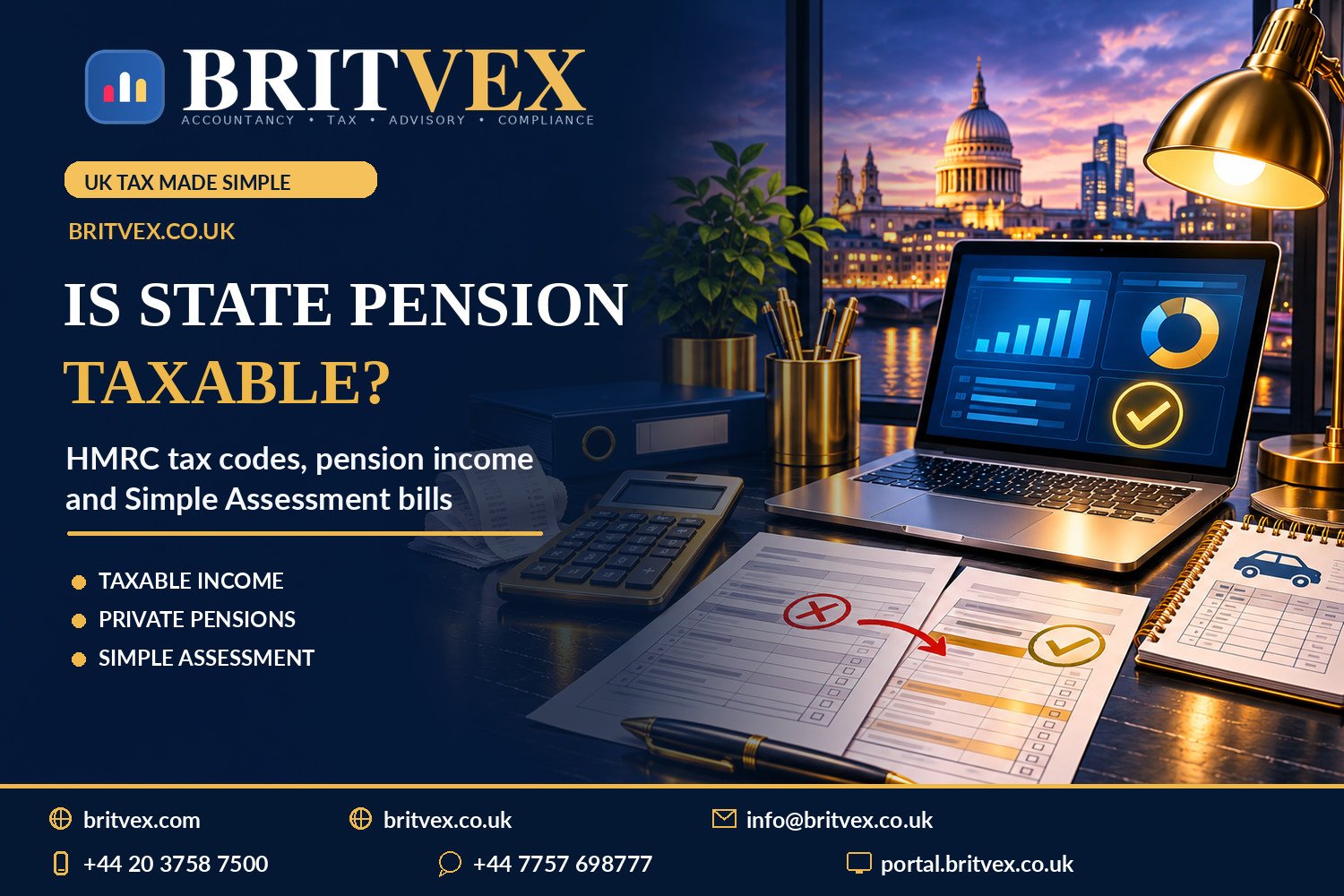
Quick answer: The UK State Pension is taxable income, but the Department for Work and Pensions normally pays it without deducting tax first. Whether you actually owe Income Tax depends on your total taxable income, allowances and the tax rates applicable where you live. If you also have a workplace or private pension, HMRC may change the PAYE code used by that pension provider to collect tax on your State Pension. If tax cannot be collected through PAYE, HMRC may issue a Simple Assessment bill instead. You do not automatically need a Self Assessment return merely because you receive State Pension.
This can be surprising. A pension payment arrives in your bank account in full, yet a later letter says HMRC has calculated additional tax. Often that does not mean a payment error or that tax is being charged twice. It means HMRC is reconciling a taxable benefit that was not taxed at source. The important questions are what pension you were entitled to receive, what other income you had, and which collection route HMRC is using.
For a practical review of a pension-tax calculation, contact Britvex through Get a Quote and select Tax advice or Self Assessment tax return. For general help understanding a notice or talking to an accountant, see First Time Using an Accountant?.
1. Is the State Pension tax-free or taxable?
State Pension is subject to Income Tax, but this does not mean everyone who receives it pays tax. The standard Personal Allowance shelters income up to an applicable amount, depending on circumstances. For the 2026–27 tax year the standard UK Personal Allowance is £12,570. Many people receiving only the standard full new State Pension have an annual entitlement under that figure, but protected or deferred additions, another pension, employment, rental income, savings interest and other taxable income can change the picture.
Three principles stop common misunderstandings:
- Taxable does not mean tax is necessarily payable. If total taxable income is within allowances, there may be no Income Tax liability.
- The State Pension is not normally taxed before payment. HMRC collects tax through other PAYE income, Simple Assessment or Self Assessment as appropriate.
- A tax calculation uses entitlement over the relevant tax year, not necessarily the total of cash deposits arriving in your bank account between April and March.
Read HMRC’s dedicated State Pension tax guidance before using an annual figure supplied by a bank-statement spreadsheet.
2. State Pension, private pension and workplace pension: which is taxed how?
| Type of income | Income Tax position | How tax is usually collected |
|---|---|---|
| UK State Pension | Taxable, subject to your allowances | No deduction from the State Pension payment itself; HMRC may collect elsewhere |
| Workplace pension | Regular taxable pension income, subject to allowances and relief rules | Pension provider usually operates PAYE |
| Private or personal pension | Taxable elements are generally subject to PAYE; lump sums have different rules | Pension provider normally operates PAYE on taxable payments |
| Employment after State Pension age | Employment earnings remain subject to Income Tax | Employer operates PAYE; National Insurance rules may differ |
| Rental or other taxable income | Depends on the income type and applicable allowances or reliefs | May involve Self Assessment or other relevant collection mechanism |
A person receiving £12,000 State Pension and £8,000 private pension does not get a fresh £12,570 allowance for each pension. Their personal position is calculated on their combined taxable income and relevant allowances. A private pension’s tax code may be reduced to recover tax attributable to State Pension.
3. What does HMRC mean by ‘annual State Pension entitlement’?
HMRC says it uses pension amounts a person was entitled to receive during the tax year, rather than just the dates and values of payments received. This matters because many State Pension payments are made every four weeks rather than monthly, and the rate normally increases in April.
If you started receiving State Pension on or after 6 April 2010, HMRC’s published full-year approach generally uses one week at the previous weekly rate plus 51 weeks at the new rate. The precise taxable amount depends on the individual’s entitlement and history, including any protected payment or deferral additions.
Illustration using the published 2026–27 full new State Pension rates
The full new State Pension weekly rate increased from £230.25 to £241.30 for 2026–27. Under HMRC’s one-week/51-week illustration:
| Component | Calculation | Amount |
|---|---|---|
| One week at previous full rate | 1 × £230.25 | £230.25 |
| 51 weeks at new full rate | 51 × £241.30 | £12,306.30 |
| Illustrative full-year taxable entitlement | £12,536.55 | |
| Standard Personal Allowance (2026–27) | £12,570.00 |
On these particular assumptions, the illustrated entitlement alone is £33.45 below the standard allowance. But if you receive more than the full new State Pension because of protected rights or other additions, or have any other taxable income, do not assume you owe no tax. HMRC’s method may differ if pension starts part-way through the year or your personal entitlement is not the standard full rate. The rate information comes from DWP’s benefit and pension rates.
Evergreen principle: The rates and allowance figures above are a dated example for the year reviewed, not fixed figures for future tax years. Always re-check them. The title and permalink of this guide do not depend on a particular year’s thresholds.
4. Why HMRC changes your private-pension or employment tax code
HMRC cannot simply deduct tax at source from the regular State Pension the way an employer deducts PAYE from wages. If another payer is already operating PAYE, the authority can adjust the tax code at that source, effectively reducing the tax-free allowance allocated there. As a result, your workplace pension statement may show a change from a normal-looking code to one with fewer tax-free pounds or even a K code.
A tax-code change is not necessarily a second tax on your State Pension
You may see an ordinary State Pension payment in full and additional tax deducted from private pension income. The correct test is whether combined annual tax has been calculated and collected accurately. A person receiving several pensions may have different codes for different providers; do not add the tax-free allowance implied by each code as though they were separate annual allowances.
The companion Britvex.com guide, Wrong Tax Code? 1257L, BR, D0 and Emergency Tax, explains the code mechanics and refund possibilities; this link should be activated once both guides are published. For official information, read How tax on a pension is paid and Why a tax code changes.
5. Example: State Pension plus a private pension
Assume a retiree living in England has £12,000 of taxable State Pension entitlement and a £9,500 taxable private pension, with no other income or adjustments and the full £12,570 standard allowance. This example uses 2026–27 main rates:
| Calculation | Amount |
|---|---|
| State Pension entitlement | £12,000 |
| Private pension income | £9,500 |
| Combined taxable income before allowance | £21,500 |
| Less standard Personal Allowance | £12,570 |
| Income subject to basic-rate tax | £8,930 |
| Illustrative Income Tax at 20% | £1,786 |
The private pension provider might collect an amount of tax through PAYE that reflects the State Pension as well as the private pension. Do not take 20% of every State Pension payment and add it to PAYE deductions without checking the combined annual calculation; that risks double-counting.
This is a simplified England example; Scottish pension-income rates are different. Savings income, dividend income, marriage-related allowances, pension drawdown, part-year pension commencement and other factors can change the result. For the applicable rates, use HMRC’s tax rates and allowances.
6. What if your only income is the State Pension?
If it is your only taxable income and the annual entitlement is below your applicable allowance, you generally will not owe Income Tax solely on it. If entitlement exceeds the allowance and tax is due, HMRC may send a Simple Assessment calculation because there is no employer or pension provider from which to deduct PAYE. This does not mean everybody with State Pension must register for Self Assessment.
What if the letter says you owe tax despite receiving only State Pension?
Check whether the entitlement is higher than you expected, whether there was protected or deferred pension income, and whether HMRC has included another income source such as savings interest or an old pension. Confirm the letter’s tax year and check the annual amount on the State Pension information from DWP.
What if you receive State Pension plus savings interest?
Interest can affect your taxable position depending on applicable savings allowances and starting-rate rules. HMRC may also include estimated interest in a PAYE coding calculation or a Simple Assessment. Avoid assuming that all interest is taxable merely because it is mentioned in a notice; consider the available reliefs and allowances.
7. What is a Simple Assessment tax bill?
Simple Assessment is an HMRC calculation that can collect Income Tax without requiring the taxpayer to complete a full Self Assessment return in that case. It is commonly used when HMRC has sufficient information to calculate tax but cannot collect the liability through an appropriate PAYE code. Pensioners with taxable State Pension and no alternative PAYE source are one potential group.
A Simple Assessment letter should show the relevant tax year, the income and other information used, the tax calculation, the amount payable, the payment deadline and a reference for paying it. It is not a request to share your HMRC password or pay an unknown third party.
How to check the calculation
- Locate the tax year and check that your identity and address are correct.
- Compare the State Pension entitlement with the DWP statement for that year.
- List every other pension, employment payment and source of taxable income shown.
- Check the Personal Allowance and any allowances or reliefs applied.
- Compare tax already deducted through PAYE with the calculation.
- Read the payment reference and deadline directly from the letter, rather than guessing from Self Assessment deadlines.
You can use HMRC’s Simple Assessment overview and its guidance on incorrect amounts.
8. Simple Assessment deadlines: payment and challenging errors
If the figures are wrong, contact HMRC within 60 days of the date on the bill. Explain which figures are wrong, your proposed correction and the evidence used. HMRC may issue a revised calculation or a decision with appeal information. A later formal appeal has its own time limit set out in the decision correspondence.
The payment deadline depends on when the letter was issued and the tax year involved, so always follow the date on the actual notice and HMRC’s current guidance rather than a generic January rule. For example, HMRC’s 2026 guidance sets different payment timing for certain Simple Assessment letters issued before and after 31 October. If HMRC is reviewing your disputed calculation, do not assume that payment is automatically suspended: follow its explicit instructions and keep records of correspondence.
If payment in full is difficult, contact HMRC early about payment options. Britvex’s Time to Pay article explains the general principles, but an agreement depends on HMRC’s assessment.
9. Is State Pension taxable in Scotland and Wales?
State Pension remains taxable UK pension income, but the Income Tax rates applicable to non-savings pension income can depend on your main residence. Scotland operates a distinct rate structure for relevant non-savings non-dividend income. Welsh income tax codes carry a C prefix, and the main rates for Wales are set under its own arrangements.
Check where HMRC records you as resident for the tax year and use its official rates information. Do not simply apply an English 20% illustration to a higher-income Scottish pensioner.
10. Does working after State Pension age change your tax position?
Income Tax can still apply to earnings after you reach State Pension age. National Insurance liability has different age-related rules: employees generally stop paying Class 1 National Insurance after reaching State Pension age, while employers may still have obligations. Check the actual employment and payroll situation rather than assuming either the pension or the job is automatically tax-free.
A working pensioner can have State Pension, wages, private pension and savings interest in one tax year. That makes it particularly important to check income estimates and PAYE coding notices. Britvex’s employer PAYE guide explains why payroll uses the code supplied by HMRC, while Payroll Services are available for businesses administering employee deductions.
11. Do you need Self Assessment when you receive State Pension?
Not automatically. A retiree whose taxable income is dealt with through PAYE and, if needed, Simple Assessment may not need a Self Assessment return. A person who is self-employed, receives relevant untaxed rental income, has other reporting obligations, or has been issued a valid notice to file may need Self Assessment for separate reasons.
If you do complete a return, the annual State Pension entitlement should be included along with the taxable private pensions and any PAYE tax already deducted. HMRC’s 7 July 2026 guidance also explains that Making Tax Digital users should check whether the State Pension amount has been included in their tax return information. Do not file a redundant tax return simply because of a tax-code notification.
For straightforward explanations of the process, see the UTR versus National Insurance guide, Self Assessment services and Britvex.com’s Self Assessment guide.
12. State Pension tax and future rule changes
Pension and personal-tax rules can change from year to year. The 2026 Budget contains forward-looking pension taxation measures, including a proposed Pensions Tax Allowance for certain eligible State Pension recipients in a future tax year. These measures should not be confused with the rules applying to the current tax-year example above, and their final operation depends on the applicable legislation and guidance.
The most reliable way to keep this guide useful is to keep the title and URL evergreen while revising tax-year calculations when official legislation changes. See Budget 2026 rates and allowances for developments; do not assume a proposed future relief already applies to the calculation on your current letter.
13. Documents to prepare if you need help
| Document | What it helps establish |
|---|---|
| State Pension award or annual uprating letter | Entitlement and rate for the relevant year |
| HMRC Simple Assessment or tax calculation letter | Figures, tax year, deadline and payment reference |
| P60s from workplace/private pension providers | PAYE pension payments and tax deducted |
| Other pension statements | Complete taxable pension picture |
| Payslips if still employed | Income, tax codes and deductions |
| Bank or interest statements if relevant | Interest and its potential tax treatment |
| Previous tax returns and HMRC letters | Earlier decisions or reporting status |
| Marriage Allowance or other allowance information | Potential adjustments to taxable income |
Send only relevant documents. For an engaged Britvex client, the secure client portal supports document uploads and messages. Do not send tax account passwords to an accountant. Our article First Time Using an Accountant? explains the onboarding process.
14. When an accountant is useful, and what Britvex can do
Many pensioners can check the simple calculations themselves using HMRC’s official guidance. Advice becomes more valuable where the calculation includes multiple pensions, part-year residence, Scotland-specific rates, savings and dividend income, rental property, an incorrect Simple Assessment, disputed PAYE amounts, or historic tax years.
Britvex can review the evidence, reconcile pension income against HMRC calculations, advise on whether Self Assessment is necessary and help with relevant correspondence within an agreed engagement. Britvex cannot guarantee an HMRC decision, eliminate tax legitimately due or promise a refund without reviewing the facts. For our legal identity and oversight disclosures, consult About Britvex, Tax Planning and Regulation & Compliance.
15. Frequently asked questions about State Pension tax
Is the UK State Pension taxable?
Yes. It counts as taxable income, but you may not actually owe Income Tax if total taxable income is below your available allowance.
Why is no tax taken off my State Pension payment?
The Department for Work and Pensions normally pays the State Pension without deducting PAYE. HMRC collects any tax due using another appropriate mechanism.
Will I pay Income Tax if State Pension is my only income?
Only if your taxable entitlement exceeds your available allowances and tax is due. The amount depends on your individual entitlement and tax year.
Why did my private-pension tax code change after I started State Pension?
HMRC may use PAYE on your private pension to collect tax due on combined taxable income, including your untaxed-at-source State Pension.
Is State Pension taxed twice if my private pension deducts more PAYE?
Not simply because the private-pension code is adjusted. Check the combined annual income, allowance and tax deducted across all sources before concluding there is double taxation.
What is Simple Assessment for pensioners?
It is an HMRC calculation and payment notice where tax is due but cannot appropriately be collected through PAYE, without requiring a full Self Assessment return for that liability.
How long do I have to dispute an incorrect Simple Assessment?
HMRC generally asks you to contact it within 60 days of the date on the Simple Assessment bill, explaining the disputed figures and supporting documents.
Does everyone receiving State Pension need Self Assessment?
No. An obligation can arise for other reasons or under an HMRC notice to file. State Pension receipt alone does not mean everyone needs an annual tax return.
Which amount do I put in a tax return: bank payments or entitlement?
Use the taxable annual State Pension entitlement calculated for the relevant tax year, following HMRC’s guidance, not simply bank payments grouped by calendar date.
Are pensioners in Scotland taxed differently?
The State Pension remains taxable income, but Scotland’s rates for relevant non-savings income differ. Use the tax rules for your applicable jurisdiction and year.
Can I receive a State Pension and still work?
Yes. Employment earnings remain relevant for Income Tax. National Insurance rules after State Pension age differ from ordinary working-age employee rules.
Can Britvex check my pension-tax bill?
Yes, within an agreed personal-tax engagement. We can review pension statements, income, codes and HMRC calculations, and assist with an appropriate return or communication when required.
16. Official sources and next steps
The main sources are How your State Pension is taxed, How tax on pensions is paid, Simple Assessment, disputing incorrect calculations, tax rates and allowances and DWP pension-rate information. The examples are educational and require adjustment for your circumstances, tax year and jurisdiction.
Unsure whether your State Pension or private pension has been taxed correctly? Send the question through Britvex Get a Quote, selecting Tax advice or Self Assessment tax return. Existing clients can send relevant records via the client portal or request assistance through portal support. You can also telephone +44 20 3758 7500 or email info@britvex.co.uk.