Quick answer: When you take a taxable lump sum or flexible withdrawal from a private pension, the provider may deduct Income Tax using an emergency Month 1 PAYE calculation. This can make the initial deduction look disproportionately high, especially if it is a one-off payment. You may be entitled to reclaim overpaid tax during the year using the correct HMRC route, commonly P55, P53Z or P50Z, depending on whether the pot was emptied and whether you have continuing taxable income. The forms are not interchangeable, and HMRC now recommends its pension tax refund checker. Eligible individuals can claim from HMRC directly without paying Britvex or a refund agency.
1. Why can HMRC take too much tax from a pension withdrawal?
A private pension withdrawal is not taxed in quite the same way as receiving interest or transferring money between ordinary savings accounts. When a pension provider makes a taxable pension payment, it normally has to operate PAYE using the information available at that time. If the provider does not hold an appropriate tax code, it may use the emergency code on a non-cumulative Month 1 basis. This assumes only a limited slice of the annual allowances and tax bands is available for that particular pay period. A one-off lump sum can therefore be treated as if similarly large payments may continue during the year.
The resulting tax deduction is an initial withholding, not necessarily the final Income Tax liability for the entire tax year. The final result depends on total taxable pension income, employment earnings, State Pension, other income, reliefs and tax already paid. A large deduction may be partly or wholly correct where the taxable payment genuinely pushes annual income into a higher band. HMRC’s technical PAYE guidance explains why the first flexible pension payment often uses the emergency Month 1 code.
2. Is every pension withdrawal taxed?
No. Pension withdrawals can contain tax-free and taxable elements. Under the general private-pension rules, a person can usually take up to 25% of certain pension value tax-free, subject to applicable limits and the form of benefit taken; the remainder may be taxed as income. But not every cash payment is automatically 25% tax-free, and some individuals have special protections or prior usage of lump-sum allowances. A pension provider should explain the actual payment breakdown. GOV.UK: how you can take your personal pension.
The key question for a refund is how much Income Tax was deducted on the taxable element compared with the person’s eventual lawful liability, not simply whether the bank received a pension payment. Money moved by a qualifying pension-to-pension transfer is a different transaction from cash withdrawn personally. If you do not know whether a payment was an uncrystallised funds pension lump sum (UFPLS), drawdown income or a small-pot payment, ask the provider before selecting a refund form.
3. Month 1 emergency tax: a simple illustration
Imagine a person receives a one-off £40,000 cash withdrawal from a pension arrangement, of which the provider confirms £10,000 is tax-free and £30,000 is taxable. If the taxable £30,000 is put through an emergency Month 1 PAYE calculation, a relatively high amount may initially be withheld. This does not mean the person’s final tax bill is automatically calculated as twelve times £30,000.
| Component | Illustrative amount | What to check |
|---|---|---|
| Total pension cash received before PAYE | £40,000 | Provider’s payment confirmation |
| Tax-free component (assumed) | £10,000 | Scheme’s actual tax-free treatment |
| Taxable component | £30,000 | Amount reported under PAYE |
| Income Tax provisionally deducted | £9,200 | Illustration only; actual PAYE varies |
| Estimated final tax attributable to this payment | £6,000 | Illustration only; depends on total annual income |
| Potential over-deduction to review | £3,200 | Not an automatic refund entitlement |
The £9,200 and £6,000 figures above are hypothetical, chosen to demonstrate reconciliation rather than quoted HMRC tables. In an actual claim, use the payment statement, tax code, tax year, all other income and current tax bands. Even if you receive an in-year repayment, HMRC can reconcile the tax again later. HMRC pension-refund guidance confirms that final checks may occur after the tax year ends.
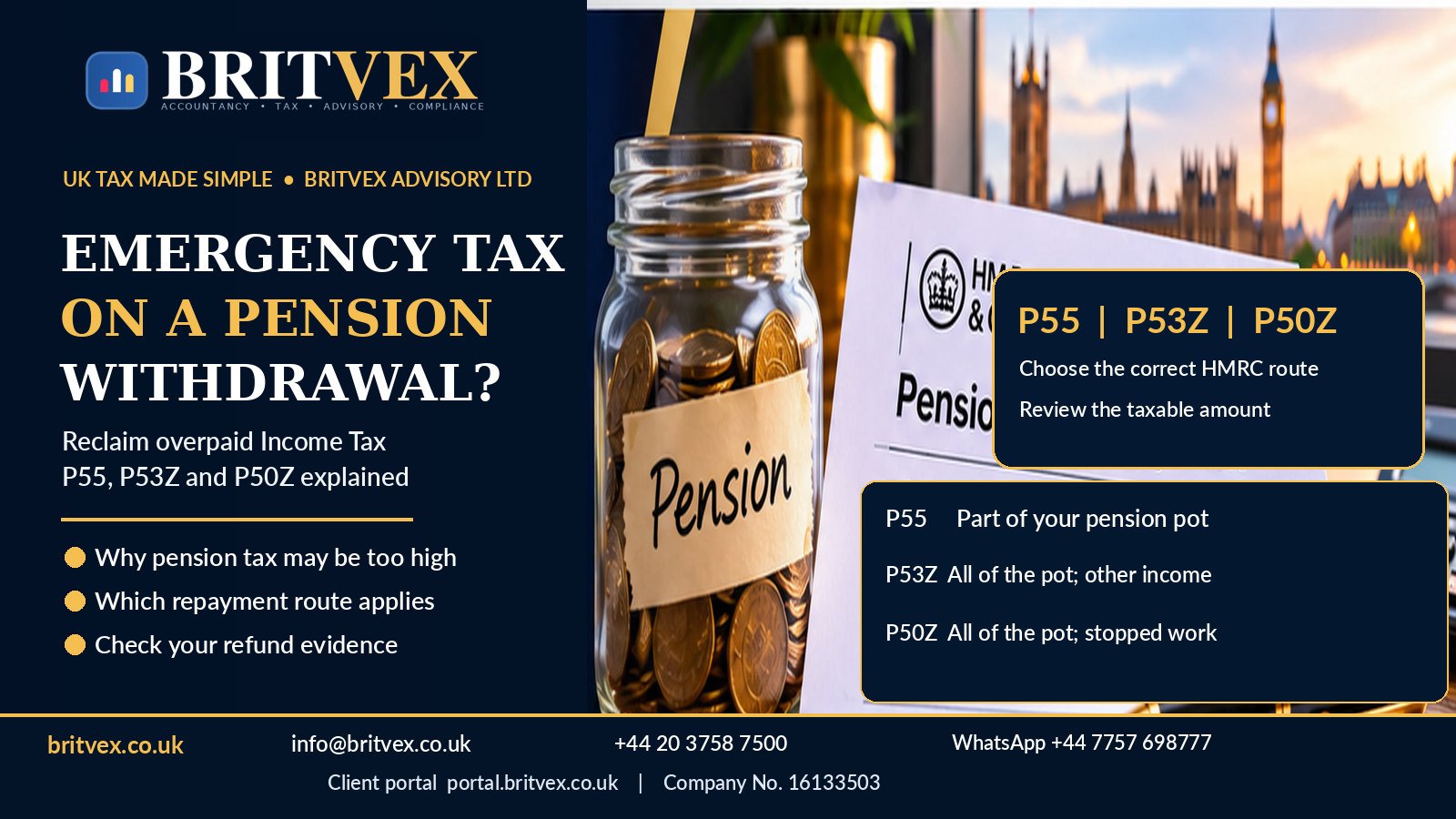
4. P55, P53Z or P50Z: the correct route
Start with HMRC’s current Check how to claim a tax refund on your pension tool. In October 2026 HMRC specifically explained that this triage tool helps customers select the correct route rather than guessing from an old form link. Pension Schemes Newsletter 186.
| Typical circumstances | Common form | Key caution |
|---|---|---|
| Flexibly accessed part of a pension pot, with money remaining | P55 | Check whether regular payments and provider corrections change the route |
| Flexibly taken all of a pension pot, with other continuing taxable income | P53Z | Include expected other income accurately |
| Flexibly taken all of a pension pot and stopped working, with no continuing taxable income other than State Pension in the ordinary case | P50Z | Do not use just because you retired from one job if other income continues |
| Certain small-pot or trivial-commutation payments | P53 or another route | A small-pot claim is not automatically a P53Z claim |
| Pension death-benefit lump sums | Specific (DB) forms or other rules | Different conditions from your own pension withdrawal |
The table describes common cases, not a substitute for HMRC’s checker. Tax residence, Self Assessment filing status and details of the pension event can affect which process is available. HMRC’s official printable forms and current explanation are on Claim a tax refund on your pension by post. A refund form is not a pension withdrawal application—it is a way to ask HMRC to review tax after an eligible payment.
5. The P55 route: taking part of your pension pot
P55 often applies when you take a taxable flexible pension payment but do not empty the pension pot. This can happen on an initial cash withdrawal where funds remain invested or in a drawdown arrangement. The specific payment pattern matters: if the provider is already making continuing regular payments and can correct the code in-year, HMRC may direct you differently. Do not assume that all pension income uses P55.
Before making the claim, identify the pension provider, date and amount of the payment, taxable/tax-free split, PAYE deducted, other expected income for the tax year and whether further pension payments are planned. The last point is essential because over-reclaiming now can create an underpayment later. HMRC’s P55 and other current forms page provides the supported route if the online checker directs you there.
6. The P53Z route: the whole pot and continuing income
P53Z usually covers a person who flexibly accesses all the money in a particular pension pot but has continuing taxable income—for example, employment income, an occupational pension or other regular taxable receipts. The fact that the pot is empty matters, but so does the rest of their annual income. A person who empties one pension pot may still have pension income from a different arrangement; the claim should present that other income honestly.
Example: Someone receives a taxable lump sum after closing a £28,000 flexible pension pot but still earns £27,000 a year through employment. Claiming as if there will be no further employment income would distort the estimated annual liability. The correct pension-refund assessment considers their remaining earnings, available allowances, tax deducted elsewhere and the timing of the withdrawal. HMRC’s P53Z guidance should be used, not a third-party PDF with unknown revisions.
7. The P50Z route: the whole pot and no continuing work income
P50Z ordinarily applies where someone has flexibly accessed all of the relevant pension pot and stopped work, without a continuing source of taxable income other than State Pension under HMRC’s ordinary conditions. It is not correct to select it merely because the person has stopped full-time work; part-time employment, self-employment or another taxable pension may require a different route.
Example: A person ceases employment in May, fully withdraws a pension pot in June and expects no further employment income but receives State Pension. P50Z may be the relevant form, depending on the other facts. If the same person takes paid consultancy work later in the year, the expected-income analysis changes and any refund can be reconciled. The checker is particularly valuable where future income is uncertain. HMRC PAYE manual on flexibly accessed pension rights.
8. How to claim your refund step by step
- Confirm receipt of the pension payment. A forecast or request to withdraw is not evidence that a taxable payment has actually been made.
- Obtain the pension provider’s statement showing the gross amount, any tax-free component, the taxable sum and PAYE withheld. Keep related P45 or payslip-style documents where issued.
- List your other taxable income for the whole tax year: employment, State Pension, other private pensions, rentals, interest and any relevant income.
- Run HMRC’s pension refund checker and answer its questions accurately.
- Follow the online claim route if offered. If HMRC directs you to a paper form, use the correct version from its official website, complete it and post it to the stated address.
- Save submission evidence and any reference. Do not share Government Gateway passwords with a third party.
- Monitor HMRC’s response using official channels, and check any repayment against the estimate and later PAYE/annual reconciliation.
HMRC’s checker asks for your NI number, pension payment/tax details, estimated other income and bank details for a repayment. The government service explains how to sign in securely. Taxpayers can use it directly for free; paying an agent is a choice, not a government requirement. Official checker.
9. How long does a pension-tax refund take?
There is no safe universal promise that every pension tax refund will arrive within a fixed number of days. HMRC may need to verify the payment, your estimated annual income, the claim form and identity or bank details. Payment timetables can change, and a claim with incomplete data may take longer. The official process now directs taxpayers to check when HMRC expects to reply rather than rely on a commercial adviser’s guarantee.
An in-year tax repayment is not necessarily the end of the matter. HMRC may review the final annual position after the tax year and contact you if the amount repaid differs from the correct final result. Retain the withdrawal statement and any PAYE information; it may also be needed for Self Assessment. Some providers may correct an initial emergency deduction through later payments, so confirm what the provider can do before making a duplicate claim.
10. P55/P53Z/P50Z versus Self Assessment
Filing Self Assessment and reclaiming emergency pension tax are related but not identical. A person with a mandatory Self Assessment return may need to include pension income and tax deducted in that annual return, even if they have already received an in-year refund. In contrast, someone with a straightforward PAYE situation may use an appropriate dedicated repayment route without a full Self Assessment filing. If you have recently started your own consultancy or other trade, check our register self-employed and obtain a UTR guide before assuming that all business income can be dealt with through PAYE. HMRC’s current checker handles the first route-selection questions.
Never claim the same tax twice. If an in-year repayment has been made, the annual tax calculation must reflect it where required. Missing refunds, overpayments or other tax entries can change the final bill. If a return has already been submitted incorrectly, Britvex has a separate guide on amending a Self Assessment tax return and offers Self Assessment services.
11. Your State Pension is different from a private pension withdrawal
The State Pension is normally taxable income but is generally paid without PAYE tax being deducted directly. HMRC may collect tax on it through a code on another pension or employment income, or in some situations through Simple Assessment. That is a different issue from an emergency code applied to a one-off private pension withdrawal. Some people experience both at the same time, which is why the projected annual income must be comprehensive.
For a separate explanation of state pension tax, see Britvex’s State Pension taxable-income guide. For errors in an ordinary PAYE tax code, see Britvex’s wrong-tax-code guide—the linked address is the verified current live permalink even though it contains a spelling error.
12. What if the person is non-resident or receives overseas income?
A non-resident who receives UK pension payments may have a different tax-residence or treaty position from a UK resident. UK withholding, local-country tax and possible relief under a double-taxation agreement must be assessed on the actual facts. The standard UK-resident P55, P53Z or P50Z process may not be appropriate, and the HMRC form instructions may direct non-residents to a separate route. This is a particularly important reason not to upload a form just because its title looks familiar.
Someone living abroad should consider residence dates, the type of pension and where the pension was earned, treaty provisions, any lifetime or lump-sum protections, and whether a UK Self Assessment return is required. Britvex can review the UK-side tax position under an agreed engagement and should not represent itself as providing regulated financial advice about when to draw a pension or the overseas country’s tax law without appropriate expertise.
13. The refund is not the only pension-tax issue to review
Flexible access may have other consequences. In some cases, triggering taxable flexible access can limit future tax-relieved money-purchase pension contributions through the Money Purchase Annual Allowance (MPAA). The availability of tax-free cash, any protections, other income and how much cash you actually need are separate retirement-planning considerations. A tax refund claim does not reverse the pension withdrawal or undo an MPAA trigger.
For pension-withdrawal choices and investment suitability, speak to a properly authorised financial adviser or a suitable pension guidance service. Britvex’s role in this article is tax reporting, reconciliations and related UK accounting assistance—not making a recommendation to withdraw or invest pension funds. HMRC MPAA guidance.
14. Common mistakes that create delays or incorrect refunds
- Choosing P50Z when still earning wages: the claim may not match the income evidence HMRC holds.
- Using P53Z for part of a pension pot: the distinction between part and all of the relevant pot matters.
- Claiming the full tax deducted as a refund: some of that tax may be correctly payable at year-end.
- Forgetting other pensions or State Pension: estimated total income becomes understated.
- Using an old PDF from a comparison website: the wrong form or route can delay processing.
- Sending a claim before the actual payment: the provider’s tax evidence will not yet exist.
- Giving an adviser the Government Gateway password: HMRC agent authorisation should be used instead where required.
- Ignoring annual reconciliation: any in-year repayment may be adjusted after the final year is assessed.
Before submitting, compare your provider documentation, the HMRC form’s eligibility wording and the income figures. Where the person is vulnerable, recently bereaved or managing an estate, identify whether there are death-benefit rules before applying the ordinary forms.
15. A simple evidence checklist to send an accountant
If you want Britvex to review the issue, prepare a redacted summary for the initial enquiry: pension provider name, month and year of withdrawal, total and taxable amounts, PAYE deducted, whether money remains in the pot, and whether employment or other pension income continues. Do not include full NI numbers, banking credentials or identification documents in the free-text quote message. The secure client portal is the appropriate place for document handling after onboarding.
A tax review may include checking the gross/tax-free/taxable breakdown, identifying the likely HMRC route, reviewing income assumptions, analysing an unexpected tax code, checking existing Self Assessment obligations and preparing the claim or HMRC correspondence where authorised. Request the scope and fee in writing through Get a Quote. Our broader personal tax services and Self Assessment service provide related help.
16. Why this matters: a verified HMRC statistics example
This is not a rare theoretical problem. In Pension Schemes Newsletter 186 (October 2026), HMRC reported processing 13,383 P55, 3,975 P53Z and 915 P50Z claims in the three months from 1 July to 30 September 2026. The total repaid was £64,962,461. The amounts are aggregate HMRC administrative figures, not a prediction of what an individual claimant will receive. Official HMRC newsletter.
The statistics explain why readers frequently search for emergency-tax refunds immediately after taking cash. But the correct editorial approach is to show the official free route, warn that not every deduction is an overpayment, and connect only genuinely complex cases to paid assistance.
Frequently asked questions
Why did my pension provider deduct so much tax from my first withdrawal?
The provider may have applied an emergency Month 1 PAYE code to the taxable amount. That can create a temporarily high deduction on a one-off large payment. Check the exact pension statement and tax code before assuming the entire deduction is refundable.
Is a pension tax refund automatic?
Not always. Some overpaid tax is corrected through later PAYE payments or annual reconciliation, while eligible people can make an in-year claim. Use HMRC’s refund checker to see the relevant route.
Which form is used if I only withdrew part of a pension pot?
P55 is a common route for eligible flexible withdrawals where part of the pot remains, subject to the payment pattern and other conditions. Confirm using HMRC’s current checker.
Which form should I use if I emptied the entire pot but still have wages?
P53Z is commonly relevant when the whole pot has been flexibly accessed and other taxable income continues. The correct claim must reflect the expected salary and other taxable income for the tax year.
Can I use P50Z if I retired?
Retirement alone does not establish eligibility. P50Z commonly applies where the whole pot was accessed and work has stopped without continuing taxable income other than State Pension under ordinary HMRC rules. Use the official tool if there is another pension or income source.
Do I reclaim all the tax deducted?
No. You can only recover amounts that exceed the proper tax liability under the applicable rules and calculation. Some of the provider’s withholding may be correct.
Is 25% of every pension payment always tax-free?
No. A 25% tax-free element often applies to qualifying pension benefits, subject to limits, prior usage, protections and the payment structure. Ask the provider for the actual breakdown.
Can I claim through HMRC directly without an accountant?
Yes. The official pension tax refund checker and eligible government claim forms are free. An adviser may be useful for complicated pensions, international positions or mixed sources of income, but is not mandatory for ordinary claims.
Will HMRC check my refund again after the tax year?
It can. HMRC says it may reconcile the final tax position after the tax year and contact you if an in-year repayment was different from the correct amount.
What if I am also required to file Self Assessment?
Use HMRC’s current claim route and account for the pension payment, tax deducted and any in-year repayment appropriately when preparing the annual Self Assessment return. Do not duplicate a tax credit.
Can a pension tax refund undo an early withdrawal or restore pension allowances?
No. It concerns overpaid Income Tax. It does not cancel the withdrawal or automatically reverse restrictions such as the Money Purchase Annual Allowance, where relevant.
Can Britvex help if my pension refund has stalled?
Britvex can review the UK tax information, identify missing evidence, check the relevant HMRC route and assist with authorised tax correspondence under an agreed scope. It cannot guarantee an HMRC decision, a refund amount or a particular processing date.
Official sources and editorial review
This article was reviewed against HMRC’s pension refund checker, current printable forms guidance, Month 1 pension PAYE manual and Pensions Newsletter 186. Editorial review: 20 November 2026. This is general tax information, not an individual pension or investment recommendation.
BRITVEX ADVISORY LTD · Company No. 16133503 · Companies House approved ACSP · HMRC AML supervised · ICO registered. These regulatory statuses do not amount to FCA authorisation for pension investment advice. Contact: Get a Quote · Secure Client Portal · Contact.