Confirmation Statement Explained: Filing Deadlines, Company Details and Common Mistakes
Britvex Insights · UK Accountancy, Tax & Company Guidance
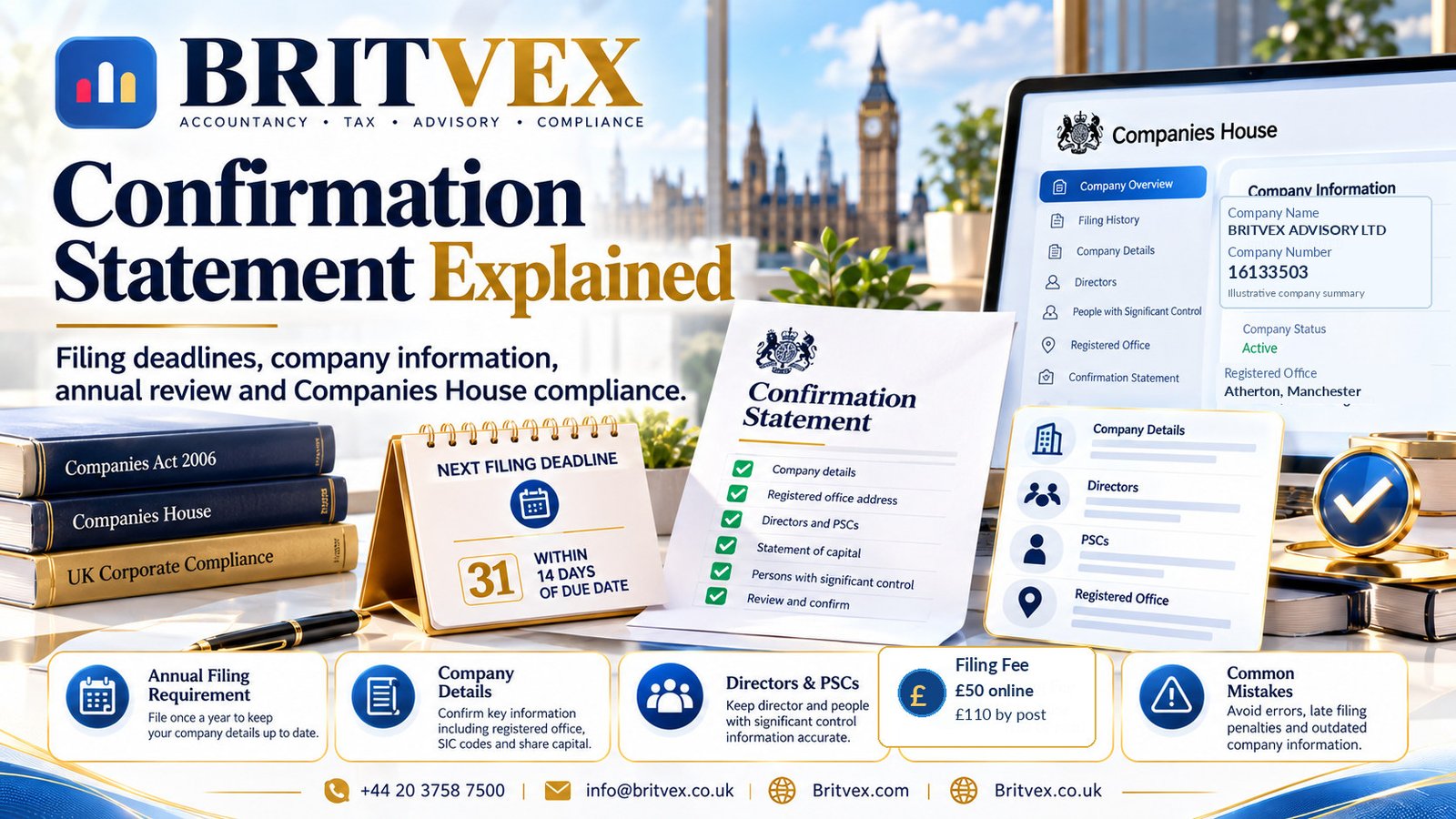
Quick answer: A UK confirmation statement is normally filed once per 12-month review period, within 14 days of its end, even where company details have not changed. The company must confirm register information and the lawful-purpose declaration; director identity verification may be needed before filing.
What is a confirmation statement?
A confirmation statement is a Companies House filing in which a UK company confirms that specified information held on the public register is accurate. It replaced the old annual return. Filing it is not the same as preparing annual accounts or sending a Corporation Tax return to HMRC. Its purpose is to maintain the public company record and make the required statements about the company’s intended lawful activities.
A confirmation statement is required even where nothing changed in the previous review period. Dormant and non-trading companies are not automatically exempt. What matters is whether the company is required to file under Companies House rules, not whether it earned revenue during the year.
For a company with several directors, shareholders or people with significant control (PSCs), a correct filing begins with checking the register and identifying changes that require another form first. Britvex’s Confirmation Statements service is focused on that sequence: review, correct, verify and then confirm.
When is a confirmation statement due?
Most companies have a 12-month review period, normally measured from incorporation for the first statement or the last confirmation statement date for later ones. A company has up to 14 days after the review period ends to submit its confirmation statement. The deadline should be checked against the company’s actual record rather than assuming it always falls on the anniversary of incorporation.
Suppose a company’s review period ends on 10 June. In that illustrative case, the company has until 24 June to file. If the company files early, the new review period begins on the day after the chosen confirmation date. Filing early can therefore alter the timetable for later years.
You can check the Companies House register and opt into email reminders. Directors should use the record’s actual due date, not an old diary entry or a general article. A short compliance calendar can align this filing with accounts, tax, director appointments and registered-office changes.
How much does it cost to file a confirmation statement?
As checked in October 2026, Companies House charges £50 for online filing and £110 for paper filing. Those are Companies House filing fees, not Britvex’s professional service fees. Fees can change, so check the official Companies House fee schedule when filing.
| Filing route | Current Companies House fee | Important point |
|---|---|---|
| Online filing | £50 | Typically the first confirmation statement in the payment period |
| Paper form CS01 | £110 | Processing may take longer |
| Additional statement in the same payment period | Normally no further annual fee | Subject to the payment-period rules |
There are two different 12-month concepts. The review period determines when the company must check and confirm its information. The payment period determines when the annual Companies House fee is due. An early filing may reset the review date without changing the fee payment-period anniversary. Do not confuse the two when a company files several statements in one year.
What details should directors review before filing?
A confirmation statement should reflect the company as it exists today. Compare the public Companies House record against internal documents, director information and shareholder records before confirming it. The goal is not to repeat last year’s details without question.
A practical checklist includes the registered office address, current directors and secretary, PSC information, principal business activities (SIC codes), share capital, shareholder information and the company’s registered email address. For companies with complex ownership or several classes of shares, the records need particular care.
Some details can be updated through the confirmation statement process; others require a separate Companies House notification. A director appointed during the year, for example, should not be left unreported until the next confirmation statement. The same principle applies to relevant PSC events and registered-office changes. Britvex’s Company Compliance service addresses the wider lifecycle of these filings.
What can be changed on a confirmation statement?
Companies House permits certain specified changes as part of the confirmation statement process. Depending on the filing route and company circumstances, these can include the SIC code, statement of capital, trading status of shares, relevant shareholder information and specified PSC-exemption details.
Changes such as a new director, removal of a director, change of registered office or change of registered email generally require their own filing procedures. PSC information has separate reporting and verification duties. A sensible sequence is to update the relevant record through the correct route before confirming that the register is accurate.
Do not assume every Companies House online filing tool can handle every company type or ownership structure. The streamlined confirmation statement service has eligibility restrictions. A company with more complex characteristics may need the broader WebFiling route or the appropriate paper procedure. Companies House’s official filing page explains the available routes.
Director identity verification and personal codes
Mandatory identity verification for relevant company roles began on 18 November 2025. Under the current transition rules, an existing director normally needs to provide their Companies House personal code in the company’s next confirmation statement. A company with several directors should check that each required director has completed the necessary verification before the filing date.
A Companies House personal code is assigned to a person, not a company. Someone who is a director of several companies can use the same code to connect their verified identity to each directorship, following the relevant filing procedures. The code should be handled carefully and provided through approved Companies House processes.
A PSC has a separate identity-verification and code-submission obligation. The applicable 14-day window depends on their role and circumstances; a PSC who is also a director may need to submit the code separately for the PSC role. Do not assume supplying a director code in a confirmation statement automatically meets every PSC requirement. See Companies House personal-code guidance and role-specific verification deadlines.
What does the lawful-purpose declaration mean?
A confirmation statement includes a declaration that the company’s intended future activities are lawful. This is not simply a check that the registered address or SIC code has remained unchanged. The declaration became part of the strengthened UK company-register regime in March 2024.
The company should make the statement through an authorised person who can reasonably confirm it. It should not be treated as a casual click-through exercise or a substitute for obtaining advice about an activity that may require a licence, tax registration or other regulatory permission.
In practice, an accurate confirmation statement has two components: the factual register review and the statutory declarations. A company facing an unresolved question about its activities should investigate that position before submitting the confirmation.
How to file a confirmation statement step by step
A careful filing workflow begins with evidence, not with the submit button. The process can be efficient when the company’s records have been maintained throughout the year.
- Locate the company’s record. Confirm its registered number, review-period end date and filing deadline.
- Compare the register with internal documents. Check directors, PSCs, registered office, SIC classifications, shareholders and capital.
- Complete separate changes first. Use the applicable process for events that cannot be corrected within the confirmation statement itself.
- Check identity-verification readiness. Obtain required director personal codes; check PSC obligations separately.
- Select the appropriate filing route. Confirm which Companies House service your company can use and have authentication details ready.
- Confirm the lawful-purpose declaration and submit. Review before submission, pay any fee due and retain evidence.
- Update the company compliance calendar. Record the new confirmation date, receipt and future review date.
For existing clients, the Britvex client portal offers a central place for company documents, queries and support communications. A portal message is not itself the statutory Companies House filing; the company must confirm that its statement was actually accepted.
Worked example: filing early and the next deadline
Imagine a company whose normal review period would end on 31 December. Its directors decide to submit an early confirmation statement dated 30 September because ownership details have been reviewed and updated. Its next review period will generally begin from 1 October, with the following statement timetable calculated under the normal Companies House rules.
This example is intended to explain timing, not to calculate a particular company’s deadline. The fee payment period is separate, so early filing does not automatically start a new annual fee cycle. The company should check its updated Companies House record following submission.
When a company is managing several compliance tasks, that distinction matters. Recording only the old incorporation anniversary can result in an avoidable missed deadline. Good company administration tracks what was actually filed, not merely what was originally expected.
Is a confirmation statement the same as annual accounts or Corporation Tax?
No. These are different legal and tax obligations, often with different dates, recipients and supporting records. Annual accounts are the company’s financial statements filed with Companies House under relevant accounting rules. The Corporation Tax return and CT600 are HMRC tax filings. The confirmation statement is a register-information review and declaration.
| Filing | Primary purpose | Typical recipient |
|---|---|---|
| Confirmation statement | Confirm prescribed company-register information | Companies House |
| Annual accounts | Report annual financial performance and position | Companies House, and accounts may support HMRC filing |
| Corporation Tax return | Report company taxable profits and tax position | HMRC |
| Change notifications | Update appointments, address or ownership events | Companies House via relevant route |
A company may need to make a director appointment notification or PSC change filing soon after an event rather than waiting for any annual deadline. Connecting Annual Accounts and company compliance work can reduce inconsistent information between systems.
Common confirmation statement mistakes
One common mistake is assuming that a dormant company does not have to file. Another is waiting until the final day to discover that directors have not provided the required identity-verification codes. Companies also confuse the review-period end with the 14-day filing window, or continue using an old annual-return date after an early statement has changed the review cycle.
It is also easy to assume a confirmation statement changes every company detail. In reality, some corrections must be made separately. A further risk is relying on old filing fees displayed on third-party pages: the correct amount is the current official Companies House charge.
Finally, keeping no evidence of acceptance creates trouble when directors change or external advisers need to reconstruct the company record. Save the filing acknowledgement, review date and the documents that supported material changes. Those records should sit alongside, but not be confused with, the company’s statutory accounting records.
What happens if a company does not file?
Companies House may take enforcement action for failure to deliver a confirmation statement. Published guidance describes potential financial penalties and the risk of removal from the register. The consequences can be significant even when the company has not been trading actively.
If the statement is overdue, first check the current register, identify any outstanding identity-verification and company-information issues, and determine the correct filing route. Resolve missing information rather than submitting an inaccurate statement merely to remove the overdue flag. Directors remain responsible for ensuring legal filing duties are met, including where an accountant or agent assists.
The best prevention is a recurring company-compliance timetable with clear owners, sufficient lead time and access to the right authentication and identification information. Britvex’s business-services guidance explains how company formation, changes, reporting and compliance fit together.
How an approved ACSP and UK compliance practice can help
A Companies House Authorised Corporate Service Provider (ACSP) is an approved identity-verification and/or filing intermediary within the relevant Companies House framework. That status is distinct from being the regulator itself. A company’s directors remain responsible for their own obligations, and the scope of an engagement should state which tasks the adviser will perform.
BRITVEX ADVISORY LTD is an approved Companies House ACSP, is supervised by HMRC for anti-money laundering purposes and maintains an ICO registration. These registrations are set out below with the company’s legal details. They support transparent client onboarding, but they should not be read as an assurance that every filing has been made or as a guarantee of any outcome.
Britvex can assist with reviewing the register, deciding which changes require separate notifications, preparing the confirmation statement, checking the director-code position and connecting the filing with company compliance support. Existing clients can sign in through the client portal for documents and support; new clients can call +44 20 3758 7500 or email info@britvex.co.uk.
Frequently asked questions
These answers summarise the main points. Check the current rules and the circumstances of the company before acting.
What is a confirmation statement for a UK limited company?
It is a Companies House filing confirming specified company information on the register and making the required lawful-purpose declaration. It replaced the annual return.
Does a dormant company still need a confirmation statement?
Yes. Companies House generally requires companies to file even when they are dormant or have not traded.
How often must a confirmation statement be filed?
At least once in each normally 12-month review period, with up to 14 days after the review period ends to file.
How much does a confirmation statement cost?
As checked in October 2026, the Companies House fee is £50 online or £110 on paper. The annual fee normally applies to the first statement in the 12-month payment period; check current official fees.
Can I file a confirmation statement early?
Yes. Early filing is allowed, but it generally starts a new review period from the day after the new confirmation date. The fee payment period is separate.
Can I change my company registered office in a confirmation statement?
No. A registered-office change should be filed using the appropriate separate Companies House process; the confirmation statement can update only specified information.
Do directors need to verify their identity before filing?
Under current rules, existing directors need to provide their Companies House personal codes with the company’s next confirmation statement. Check every required director before filing.
Is a director personal code also enough for PSC verification?
Not necessarily. PSCs have their own verification and code-submission requirements. Someone who is both director and PSC may need to provide the code separately for each role.
What if there were no changes to the company during the year?
A confirmation statement is still required. The purpose is to confirm the existing register information and required declaration, including when nothing changed.
What is the lawful-purpose declaration?
It confirms that the company’s intended future activities are lawful. It is part of the confirmation statement requirement and must be made appropriately.
Is a confirmation statement the same as filing annual accounts?
No. Annual accounts report financial information, while a confirmation statement addresses the company register. Their deadlines and processes are different.
Can Britvex help with a confirmation statement and director verification?
Britvex is an approved Companies House ACSP and provides company-compliance support subject to engagement scope. Existing clients can use the secure Britvex portal for relevant documents and support.
Need help with confirmation statement filing and company compliance support?
Britvex provides UK accounting, compliance and business support. We can agree the documents, deadlines, scope of work and appropriate next steps for your company.
Explore the Britvex service Client Portal — login & support
Call +44 20 3758 7500 · Email info@britvex.co.uk
Britvex professional registration & client access
BRITVEX ADVISORY LTD is registered in England and Wales, company number 16133503, with its registered office in Atherton, Manchester.
- Companies House: approved Authorised Corporate Service Provider (ACSP).
- Anti-money laundering: supervised by HMRC, registration XNML00000219568.
- Information Commissioner’s Office: ICO registration ZA013667080.
Britvex is part of The Syed Group. Founder: Syed Raheel Shahzad. Registration and supervision relate to the stated professional activities; they do not imply Companies House, HMRC or ICO endorsement of individual articles.
Existing clients: use the Britvex Client Portal for document exchange, enquiries and support. General enquiries: info@britvex.co.uk or +44 20 3758 7500.
Official guidance and useful references
- Companies House: Filing your confirmation statement
- Companies House: Fees
- Companies House: Verify your identity
- Companies House: Personal codes
- Companies House: Verify identity for each role
- Confirmation statement service at Britvex
Regulatory requirements and prices may change. This guide was reviewed on 19 October 2026 and is general information, not a substitute for considering a company’s particular circumstances.