UK Corporation Tax Rates 2026: 19%, 25%, Marginal Relief and Associated Companies Explained
BRITVEX INSIGHTS · CORPORATION TAX & LIMITED COMPANIES · 16 OCTOBER 2026
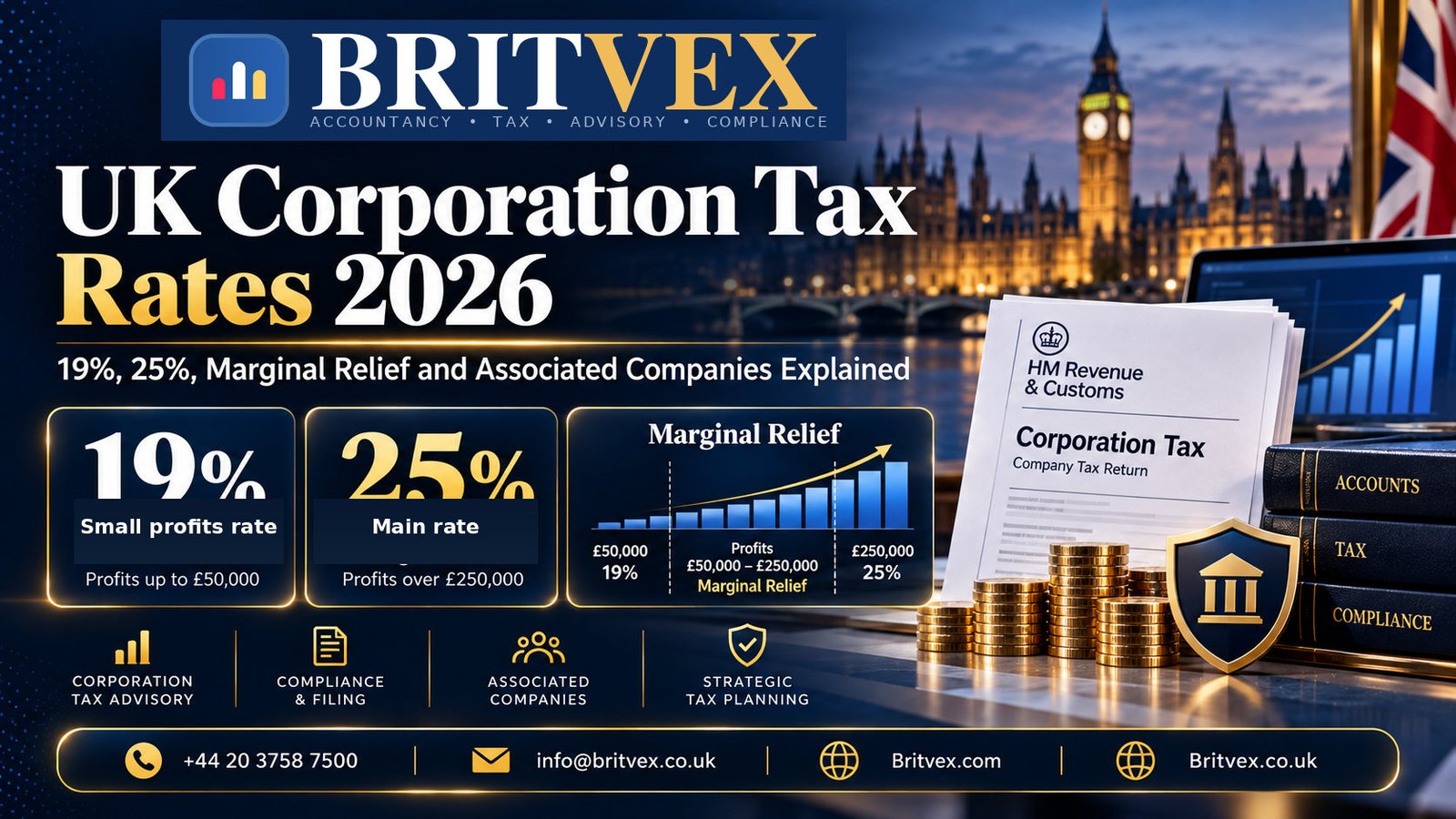
Quick answer: the standard UK Corporation Tax rates for 2026 are 19% for eligible small profits and 25% at the main rate. Eligible companies between the applicable £50,000 and £250,000 full-year limits may receive Marginal Relief. The profit limits can be reduced by associated companies or shorter accounting periods.
What are the UK Corporation Tax rates for 2026?
For the 2026 financial year, the standard Corporation Tax main rate is 25% and the small profits rate is 19%. An eligible standalone company with a full 12-month accounting period and taxable profits at or below £50,000 will ordinarily be within the small profits rate, while profits at or above £250,000 generally fall under the main rate. Between the applicable limits, Marginal Relief may reduce the tax otherwise charged at 25%.
These figures apply to taxable company profits, not the sales figure shown in turnover reports. The calculation can change with associated companies, short periods, augmented profits, company status or special regimes. Treat any online calculator that simply selects a rate using company turnover as a warning sign.
The Corporation Tax rates table UK company directors need
| Company position (standard 12-month case) | Broad rate treatment | Important qualification |
|---|---|---|
| Taxable profits £50,000 or less | 19% small profits rate | Assumes no threshold reductions or exclusions |
| Profits above £50,000 and below £250,000 | 25% main rate less Marginal Relief | Augmented profits and eligibility must be examined |
| Taxable profits £250,000 or above | 25% main rate | Some companies/profits have specialist rules |
| Associated company or short period | Reduced profit limits may apply | Recalculate before assigning a rate |
Corporation Tax is not necessarily the same as the tax shown in a business-plan spreadsheet. Book profit requires adjustments for disallowable costs, capital allowances, taxable gains, brought-forward losses and other tax differences before the final CT600 computation is prepared.
Why the Marginal Relief band is not a simple 19%/25% tax-bracket system
A common misconception is that the first £50,000 of profits is taxed at 19% and everything above it is taxed at 25%. UK Corporation Tax Marginal Relief is more technical: the starting point is the main rate of 25%, from which an eligible relief amount is deducted for profits between the applicable boundaries. This creates a gradual movement in the overall effective tax rate from 19% towards 25%.
The effective incremental rate on additional taxable profit can be 26.5% within the standard band for an uncomplicated company. This is why an owner should distinguish the main statutory rate, the effective whole-profit rate and the marginal tax on the next pound of profit.
Corporation Tax on £50,000, £100,000, £200,000 and £250,000 profit
The following illustration assumes one standalone UK-resident trading company, no associated companies, a full 12-month period, no complicating exempt distributions, taxable total profits equal to augmented profits, and standard Corporation Tax treatment. It is not a quote or a substitute for a full CT computation.
| Taxable profits | Tax before relief at 25% | Marginal Relief | Illustrative Corporation Tax | Overall effective rate |
|---|---|---|---|---|
| £50,000 | £12,500 | £3,000 equivalent small-profits reduction | £9,500 | 19.00% |
| £100,000 | £25,000 | £2,250 | £22,750 | 22.75% |
| £200,000 | £50,000 | £750 | £49,250 | 24.625% |
| £250,000 | £62,500 | £0 | £62,500 | 25.00% |
The £50,000 row is shown to compare the small profits result with a 25% main-rate starting point; at or below the applicable lower limit the 19% small profits rate applies rather than claiming marginal relief as such. At £100,000, the illustrative saving from Marginal Relief is £2,250. At £200,000, it has reduced to £750.
How HMRC’s marginal relief formula works
For an eligible straightforward computation, HMRC’s technical formula can be expressed as Marginal Relief = (F × (U − A)) × (N ÷ A), where F is the standard fraction (3/200, or 0.015), U is the adjusted upper limit, A is augmented profits, and N is taxable total profits. The resulting relief is deducted from Corporation Tax calculated at the main rate.
For the £100,000 simplified example: £250,000 − £100,000 = £150,000; multiplied by 0.015 gives £2,250 of Marginal Relief. Tax at 25% is £25,000, so the net liability is £22,750. If augmented profits differ from taxable profits, or limits are adjusted, the formula cannot be shortened in this way.
Why the 26.5% marginal rate matters for business planning
With standard limits, an additional £10,000 of taxable profits inside the marginal band may increase the Corporation Tax bill by approximately £2,650, provided the simplified 26.5% incremental rate conditions hold. The company still has more post-tax profit; the fact that the marginal rate is 26.5% does not mean growth is financially undesirable.
The rate is relevant for scenario modelling: purchasing qualifying equipment, pension planning, loss relief, dividends, profit extraction and timing of legitimate deductible expenditure all affect tax and cash flow differently. No business should incur an unnecessary £1 expense merely to save a fraction of £1 in tax.
Associated companies: when £50,000 and £250,000 are reduced
Associated companies are a major reason two businesses with the same profit may face different effective Corporation Tax outcomes. Broadly, companies can be associated where one controls the other or both are controlled by the same person or persons under the statutory rules. The number of associated companies can reduce the rate thresholds: with one other associated company, standard limits generally fall from £50,000/£250,000 to £25,000/£125,000.
| Relevant company count | Adjusted lower limit | Adjusted upper limit |
|---|---|---|
| 1 (no others associated) | £50,000 | £250,000 |
| 2 (one other associated) | £25,000 | £125,000 |
| 3 (two others associated) | £16,666.67 approximately | £83,333.33 approximately |
| 4 (three others associated) | £12,500 | £62,500 |
HMRC rules on the time of association, control, non-trading companies and other exclusions can alter the count. Shared directors or the presence of two Companies House registrations do not by themselves answer the legal control test. A company group should map shareholders, voting rights, persons acting together and actual control before filing.
Worked comparison: a company with £60,000 taxable profit
Assume a full-year company with taxable and augmented profits of £60,000. With no associated companies, the standard £50,000–£250,000 relief band gives an illustrative Corporation Tax liability of £12,150 (£15,000 minus £2,850 relief). If it instead has one associated company and the adjusted limits are £25,000 and £125,000, the simplified relief becomes £975, producing an illustrative Corporation Tax liability of £14,025. The difference comes from the adjusted relief thresholds, not from applying a new headline statutory rate.
Short accounting periods also alter the profit limits
Where the Corporation Tax accounting period is shorter than 12 months, the usual lower and upper limits are generally proportionately reduced. A six-month period, for example, can require half-year limits before associated-company adjustments. The year-end shown in Companies House records does not always align with the Corporation Tax accounting period, especially in a company’s first year or after changes.
Taxable profits versus accounting profits: the bridge directors should review
The accounts may show one profit number while the tax computation shows another. Common reconciling items include client entertainment, depreciation replaced by capital allowances, capital disposals, income recognised differently for tax, losses and relevant reliefs. This is why annual statutory accounts should be reconciled to the Corporation Tax return rather than copied into CT600 without a tax-adjustment schedule.
For investment planning, assess the Annual Investment Allowance and other qualifying capital-allowance rules, alongside cash availability, commercial need and actual eligibility. R&D claims also require careful evidence and reference to the regime applicable to the accounting period; they are not a universal percentage discount on any technology purchase.
Corporation Tax payment and CT600 filing deadlines in 2026
For companies under the normal payment timetable, the tax-payment deadline is usually nine months and one day after the end of the Corporation Tax accounting period. The CT600 Company Tax Return is generally due 12 months after that period ends where HMRC has issued a notice to file. Those are separate deadlines; payment frequently comes before final filing.
| Illustrative accounting period end | Corporation Tax payment (normal regime) | CT600 filing deadline |
|---|---|---|
| 31 December 2026 | 1 October 2027 | 31 December 2027 |
| 31 March 2026 | 1 January 2027 | 31 March 2027 |
| 30 June 2026 | 1 April 2027 | 30 June 2027 |
Companies with large profits may be subject to instalment payments before the ordinary nine-month-and-one-day date. The commonly cited £1.5 million threshold is affected by associated-company rules and other detailed tests, so do not treat it as a fixed size threshold for every company. Late payment can lead to interest and late returns can attract separate penalties.
Companies House accounts are not your Corporation Tax return
Directors must distinguish statutory accounts filed with Companies House from the Corporation Tax computation and CT600 filed with HMRC. They serve different purposes, and one submission does not complete the other. Where a company has two Corporation Tax periods inside one statutory accounts year, the business may need two CT computations and returns.
Company directors should build one compliance calendar including accounts, confirmation statements, Corporation Tax payment dates, CT600 submissions, VAT (where relevant) and payroll reporting. Britvex’s company compliance service and Corporation Tax support should be coordinated around the same records.
Eight common Corporation Tax errors that create unnecessary risk
- Using annual turnover, not taxable profit, to pick a Corporation Tax rate.
- Assuming 19% applies to the first £50,000 like a personal tax band.
- Ignoring associated companies or common-control arrangements.
- Using full-year thresholds for an accounting period shorter than 12 months.
- Calculating marginal relief without checking augmented profits.
- Relying on accounting depreciation instead of reviewing capital allowances.
- Missing the earlier tax payment date while focusing on CT600 filing.
- Assuming submitting Companies House accounts also submits a Company Tax Return.
Practical year-end Corporation Tax checklist for UK limited companies
- Confirm the company’s Corporation Tax accounting period, status and relevant financial year rates.
- Reconcile trial balance, bank balances, sales, costs and director loan accounts.
- Build a schedule reconciling accounting profit to taxable total profits.
- Identify augmented-profit items and validate company classification and any exclusions.
- Map associated companies and calculate adjusted lower/upper limits.
- Review capital allowances, losses and relevant relief claims with evidence.
- Prepare the tax calculation, verify marginal relief and model expected payment cash flow.
- Confirm HMRC Corporation Tax payment details, CT600 filing arrangements and Companies House accounts deadlines separately.
- Retain board-approved accounts, computation, submission confirmation and the records supporting material tax positions.
Frequently asked questions: UK Corporation Tax rates and Marginal Relief
What is the Corporation Tax rate in the UK in 2026?
The main rate is 25% and the small profits rate is 19%. Eligible companies with profits between the applicable lower and upper limits can receive Marginal Relief. Special rules can apply to some companies and profits.
Do limited companies pay 19% tax on their first £50,000 of profit and 25% on the rest?
No. Corporation Tax is not calculated as a simple 19% then 25% slice system. Within the Marginal Relief band, the computation starts with the 25% main rate and deducts Marginal Relief.
Why do accountants mention 26.5% Corporation Tax?
For a straightforward standalone company with a full 12-month period and no complicating distributions, additional taxable profits between £50,000 and £250,000 can carry an effective marginal Corporation Tax rate of 26.5%. That is not a universal flat rate.
What is the Corporation Tax bill on £100,000 profit?
For an illustrative standalone company with £100,000 taxable total and augmented profits, a full accounting period and no associated companies, tax is £25,000 at 25% less £2,250 Marginal Relief, giving £22,750. Actual computations may differ.
What are the £50,000 and £250,000 thresholds?
They are the standard full-year lower and upper profit limits for small-profits-rate and Marginal Relief calculations. They may be reduced for short periods and associated companies, and the calculation also considers augmented profits.
What is an associated company for Corporation Tax?
Broadly, companies can be associated where one controls the other or both are under common control. Control and substantial commercial interdependence can require detailed assessment. Associated-company counts can reduce the rate thresholds.
If I have two companies, are the thresholds halved?
If there is one other associated company within the relevant rules, the standard limits may divide by two, becoming £25,000 and £125,000. This is not automatic for every pair of companies merely because the same director is involved.
Is Corporation Tax paid nine months after year end?
For companies within the normal payment regime, payment is due nine months and one day after the end of the Corporation Tax accounting period. Larger companies can have instalment-payment obligations and different deadlines.
When is a CT600 Company Tax Return due?
Usually within 12 months after the end of the Corporation Tax accounting period if the company receives a notice to file. Payment and filing deadlines are separate: payment commonly comes first.
Do Companies House accounts and a CT600 have the same deadline?
No. Statutory accounts go to Companies House under company law, while the CT600 and corporation tax payment go to HMRC under separate rules. Their deadlines may differ and first-year cases need additional attention.
Does a company with a loss still need to file a CT600?
If HMRC has issued a notice to deliver a Company Tax Return, the company generally must submit it even if there is no Corporation Tax payable or it made a trading loss.
Can R&D claims and capital allowances reduce Corporation Tax?
Reliefs and allowances may reduce taxable profits if all conditions are met and correct claims are made. The rules differ by expenditure, accounting period and relief regime; no saving should be assumed without eligibility evidence.
Related Britvex support: Accountancy · Tax · Business
Review your Corporation Tax calculation with Britvex
Britvex can connect your accounts, taxable-profit adjustments, associated-company review, Marginal Relief calculation, CT600 preparation and Corporation Tax payment timetable, using the company records behind each figure.
Discuss Corporation Tax with Britvex →
Phone: +44 20 3758 7500
Email: info@britvex.co.uk
Websites: Britvex.com · Britvex.co.uk
Portal: Client login
Official UK references and editorial review
- HMRC — Corporation Tax rates and allowances (2026)
- HMRC — Corporation Tax rates
- HMRC — Marginal Relief
- HMRC — Marginal Relief calculation (technical manual)
- HMRC — Associated companies
- HMRC — Paying Corporation Tax
- HMRC — Company Tax Returns
- HMRC — CT return obligations
Reviewed 16 October 2026. General regulatory and tax guidance only; individual obligations can depend on facts, supply classification, control arrangements and later HMRC changes. Illustrative examples are not personal tax advice.
About Britvex: BRITVEX ADVISORY LTD (Company No. 16133503) provides UK accountancy, bookkeeping, tax, payroll, compliance and business advisory services. Registered office: 27 Gadbury Fold, Atherton, Manchester M46 0GN. Regulation and compliance details.
Founder and group: Britvex is part of The Syed Group Ltd, led by founder and Group CEO Syed Raheel Shahzad. The Britvex operating company remains a distinct registered legal entity.
Britvex contact: +44 20 3758 7500 · info@britvex.co.uk · Britvex.com · Britvex.co.uk · Client portal.